

Client
Independent audit — Amazon.in
Practices
Advisory · Intelligence
- Overall AI readiness
- 54/100
- AI crawlers addressed
- 0 of 13
- Queries surfacing Amazon.in on Gemini
- 1 of 10
- Automated checks run
- 399
Why we audited a company nobody asked us to
Buying behaviour is moving, quietly and quickly. A shopper who would once have opened Google now opens ChatGPT, Gemini, Perplexity, or Copilot and types the thing they actually want — "a decent air conditioner for a 2BHK in Bangalore", "wireless headphones under ₹25,000" — and expects the assistant to do the shortlisting. Discovery is being decided one step earlier than it used to be, and by software that reads pages very differently from a search crawler.
We wanted to know how ready a serious e-commerce operation is for that, so we picked the largest one in India and measured it from the outside, with no access and no brief. If a platform with Amazon's resources has gaps here, they exist almost everywhere else too — which is the reason to publish this rather than keep it.
The audit ran 399 automated checks across nine modules against the live site, then paired them with ten real shopping conversations on three assistants. Instrumentation tells you what a page contains; conversations tell you whether any of it reaches a buyer.
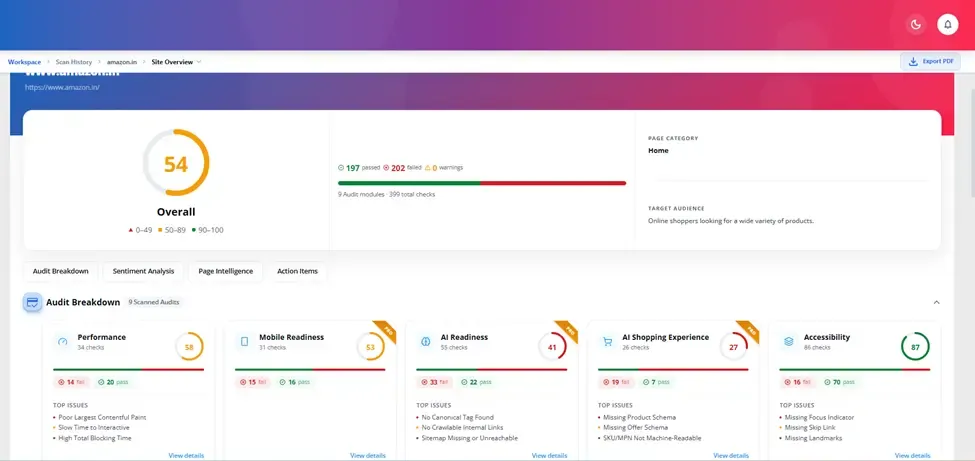
Module scores from the automated pass, before live testing.
What the instrumentation found
The technical findings cluster into three groups, and the first is the one that matters most.
- No product schema anywhere. Not one product page publishes structured data. An assistant cannot read a name, a price, or an availability state, so it cannot quote one — it has to find that information at a retailer that does publish it.
- No AI crawler policy at all. Thirteen significant AI crawlers go unmentioned in robots directives. With no instruction either way, nothing is deliberate: the site is neither opening itself to answer engines nor holding anything back from training ones.
- No canonical tag on the homepage. Multiple URLs for the same page are read as competing sources rather than one, diluting whatever authority each carries.
Performance is the second group. First contentful paint lands at 4.7 seconds against an industry target under 1.8; the largest element takes 11.3 seconds against a target of 2.5. Mobile readiness scores 27/100 — a hard number to sit with on a platform where most Indian shoppers browse and buy on a phone.
The third group is trust signalling, and it is the cheapest to fix. There is no Organization schema and no About page linked from the homepage, so an assistant has no straightforward way to confirm who runs the site. Promotional language runs at more than five times the density that reads as informative, and answer engines consistently rank that kind of copy below plainer prose. Accessibility is incomplete too: heading structure, touch target sizes, and skip links are all short of standard.
Then we stopped measuring and started shopping
Numbers describe a page. Conversations describe a business. We ran ten genuine shopping journeys across ChatGPT, Gemini, and Perplexity, including multi-turn ones where a buyer narrows down as they go.
- ChatGPT returned Amazon.in in 7 of 10 queries, holding up across refinements like "now show me the best sellers". That result owes more to its search integration and training data than to anything Amazon publishes — which makes it a flattering number rather than a reassuring one.
- Gemini returned Amazon.in in 1 of 10. Given how tightly Gemini sits against Google Shopping, this is the single most commercially urgent finding in the audit.
- Perplexity lost the thread entirely in one journey, returning options under ₹3,000 in a conversation whose budget had been established at ₹25,000. Without variant-level data to anchor to, context does not survive a multi-turn exchange.
- No platform surfaced Amazon.in for policy questions — damage on arrival, delivery timelines — despite those being asked by people close to buying.
- Attribute filters returned nothing. "Fridges rated four stars and above" produced no Amazon results anywhere, because there is no exposed rating data to filter on.
The healthy-looking number is the misleading one. ChatGPT's 7 of 10 is borrowed visibility; Gemini's 1 of 10 is the one that reflects what the site itself publishes.
What we would fix, in order
None of this needs a redesign. Every gap has an engineering answer, and they sequence naturally by how much visibility each unlocks per unit of work.
- Publish product data as JSON-LD on every product page: name, brand, price, availability, rating. This one change is what makes a catalogue eligible for AI shopping surfaces at all.
- Write an explicit AI crawler policy. Decide, deliberately, which answer engines may read the catalogue and how training crawlers are treated. Silence is a decision made by default.
- Repair the homepage's trust signals. Organization schema, a linked About page, and factual copy in place of promotional density — the things a citation system checks before quoting a source.
- Get first load under two seconds through image optimisation, deferred scripts, and server rendering of critical content. It pays twice, in AI visibility and in conversion.
- Instrument AI referrals. Without channel grouping for assistant traffic there is no way to measure whether any of the above worked.
What is already strong
This is not a takedown, and reading it as one would miss the point. Amazon.in's classical SEO is genuinely good: canonical handling across product pages, mobile-first indexing, and internal linking are all solid, and they represent real long-term investment. Market sentiment scores 100/100 — demand is not the problem. The mobile experience itself is a strength, with filtering, sorting, and add-to-cart all easy to reach. Infrastructure serves millions of daily sessions over a capable CDN, which tells you the performance numbers are implementation choices rather than capacity limits.
That foundation is exactly why the score is recoverable. The AI readiness work is an extension of what already works, not a replacement for it. A platform with no search discipline would have a much longer road than this one does.
The transferable lesson
A 54 is not a story about one retailer. It is what happens when a site is optimised thoroughly for the channel that mattered for twenty years while a second channel quietly grows alongside it, reading pages by different rules. The audit is repeatable on any catalogue, and in our experience the same three gaps — absent structured data, no crawler policy, thin entity signals — show up nearly every time.