
The project at a glance
Serving event audiences and the teams behind them
The education team needed a stronger way to publish and promote a varied event program. Public visitors needed relevant listings they could search and filter, while internal stakeholders needed visibility into event records, previews, and publishing status.
Supporting both audiences required more than a new page. The brief included a scalable listing platform, an automated path from submission to publication, and a measurement framework for understanding event discovery and engagement.
Two interfaces connected by one publishing workflow
We designed the platform around a public education events page and a SharePoint-based management dashboard. The public experience followed established patterns from the client's events platform, while the internal interface gave staff tools to manage, preview, filter, and track event information.
An intake tool validates event submissions and sends approved records to both destinations through automated workflows. Dedicated Azure infrastructure supports this process, bringing the public experience and internal administration together without requiring staff to repeat the publishing work on each platform.
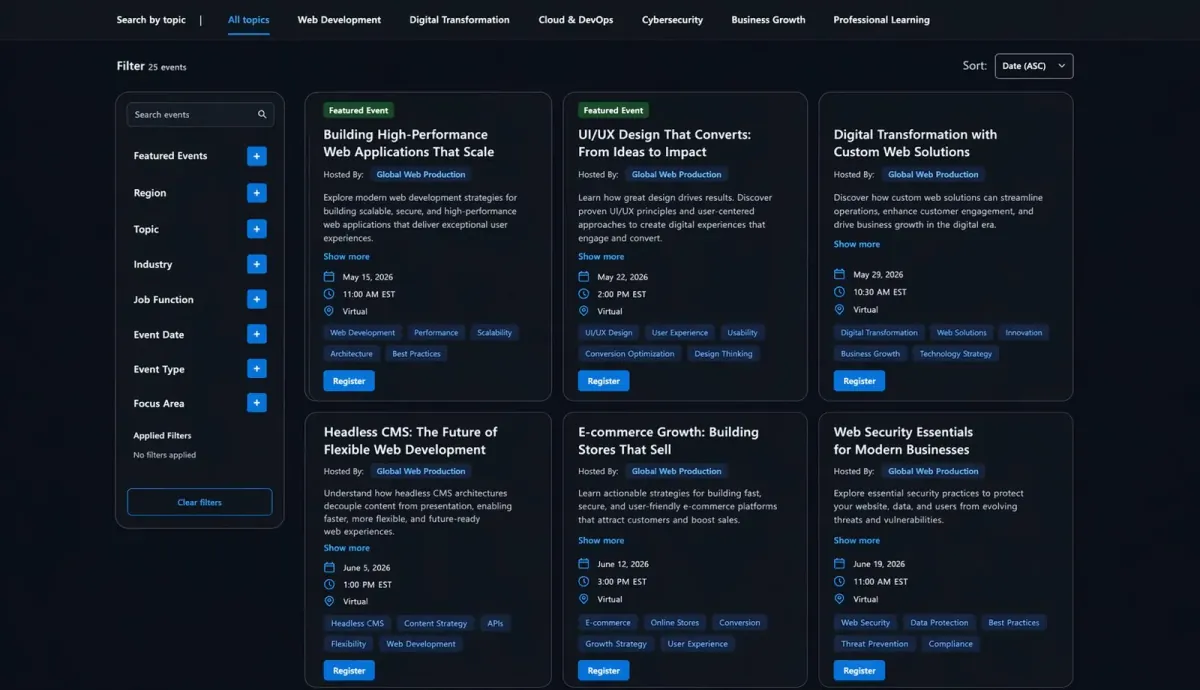
Search, filters, and event details help visitors find relevant sessions in one place.
Making events discoverable and measurable
Search and filters help visitors narrow the public listing by event type, date, region, and audience. Those options support different discovery needs, from finding a nearby session to locating an event for a particular learning audience.
Analytics tags and an accompanying measurement plan connect the browsing experience to reporting. Initial views and dashboards give the team a way to examine event visibility and engagement, supporting decisions about future programming and promotion.
What the delivery included
- A public events destination: searchable listings with event type, date, region, and audience filters, plus analytics instrumentation.
- A SharePoint management dashboard: event previews, record management, filtering, and status visibility for education stakeholders.
- Automated intake and publication: validation of submissions and distribution of approved event information to both destinations.
- Dedicated Azure infrastructure: App Service, Logic Apps, and Functions configured to support the application and its workflows.
- A measurement foundation: tagging specifications, analytics implementation, and initial reporting views for discovery and engagement.
Less repeated administration, clearer event discovery
The connected workflow reduces the need to re-enter event information across systems, addressing a source of manual errors and delays between submission and publication. Educators gain a dedicated place to find learning opportunities, while staff retain the administrative view they need to manage the program.
Built-in reporting also gives the team a clearer basis for assessing which events attract attention. That visibility connects day-to-day publishing with longer-term planning, helping stakeholders use discovery and engagement information when shaping future event programs.
Technology used in the engagement
Azure App Service hosts the application infrastructure, with Logic Apps and Azure Functions supporting automation. SharePoint provides the internal management surface, and analytics instrumentation connects event discovery to reporting.
Questions We Get Asked
Visitors needed to discover events, while staff needed to manage records and publishing status. Separate interfaces served those roles through a connected workflow.
The intake tool validated submissions, then automated workflows distributed approved event records to the public listing and the internal platform.
The implementation included tagging and initial reporting views for event discovery, visibility, and engagement, giving stakeholders information to support future event planning.